The Rebuild Tax: The Hidden Cost Every Email Team Is Already Paying
There’s a cost sitting in your email team’s workload that nobody has given a name to. It doesn’t show up as a budget line item. It doesn’t get flagged in sprint retrospectives. It just quietly accumulates, sprint after sprint, quarter after quarter.
I’ve started calling it the Rebuild Tax.
Here’s what it is, why it matters, and why almost every email team in the world is paying it right now.
What the Rebuild Tax actually is
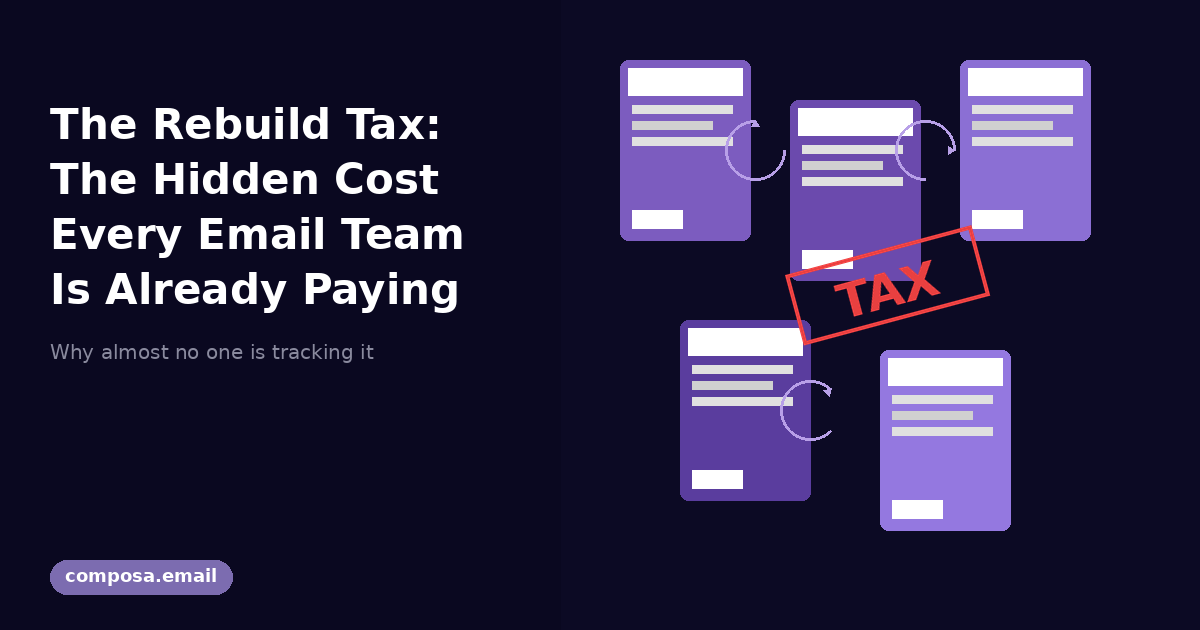
The Rebuild Tax is the recurring production cost your email team incurs every time something changes upstream — in your Figma design system, your brand guidelines, your component library, or your design tokens.
When a designer updates a button radius in Figma, that change doesn’t flow into your email templates. It can’t. Your email builder doesn’t know Figma exists. So someone on your email team has to open every affected template, find every instance of that button, manually update it, re-test it, and re-export it.
That’s the tax. It’s the gap between where your design lives and where your email production happens.
The design team ships an update in 20 minutes. The email team spends two days catching up.
How it shows up in practice
The Rebuild Tax doesn’t always arrive as a dramatic, visible sprint. More often it shows up as:
- A campaign delayed because someone’s still updating templates after a brand refresh
- A QA ticket raised because one template has the old button colour and went out to 50,000 people
- A ‘maintenance sprint’ that the team knows is coming every time design makes a change
- An email developer who spends more time rebuilding than building
It becomes invisible because it becomes normal. Teams stop questioning it. It gets absorbed into estimates, into timelines, into the way work works. ‘That’s just how email is.’
It isn’t. But when you’ve never seen it work differently, it’s hard to imagine that it could.
Why it’s getting worse
Design systems are maturing fast. More companies are building proper, token-based Figma systems with component libraries, variable sets, and documented design decisions. That’s genuinely good for design quality and brand consistency.
The problem is that email production hasn’t moved at the same pace. The tooling hasn’t caught up. Most email template builders — even the enterprise ones — have no concept of a design token, no Figma integration, no mechanism for downstream propagation.
So as your design system gets more sophisticated, the gap widens. Every new component your designer builds in Figma is another rebuild waiting to happen on the email side.
The more mature your design system, the higher your Rebuild Tax.
What it’s costing you (roughly)
Most email teams we speak to have never actually added up their Rebuild Tax. When they do, the number is usually uncomfortable.
A reasonable estimate for a mid-sized email team managing 40–80 active templates:
- Average template update (find, edit, test, QA): 45–90 minutes
- A typical design system change affecting 30% of templates: 12–24 hours of rebuild work
- Design system changes happening 3–4 times per year: 36–96 hours annually
That’s before you account for mistakes made during manual updates, campaigns delayed, and the opportunity cost of email developers doing maintenance instead of building new things.
It’s not a catastrophic number. But it’s not nothing. And unlike almost every other production cost in your stack, this one is entirely avoidable with the right tooling.
Why nobody talks about it
The Rebuild Tax doesn’t have a line item because it’s diffuse. It spreads across sprints, across team members, across different types of work. Nobody owns it. Nobody measures it. It’s just... the cost of doing email.
The other reason: there hasn’t been an alternative until very recently. When there’s no solution, naming the problem feels like complaining. So teams learn to absorb it.
But the solution exists now. And once you’ve seen what it looks like when design system updates flow directly into production-ready email templates — automatically, without a rebuild — the tax becomes very hard to justify paying.
The first step is naming it
We didn’t invent the problem. We just gave it a name.
The Rebuild Tax is real, it’s widespread, and it’s been hiding in plain sight in email teams’ sprint boards for years. The first step to addressing it is recognising it for what it is: not a process failure, not a people problem, but a tooling gap that has a concrete cost.
If you want to find out what your team’s Rebuild Tax looks like — and whether there’s a better way to work — that’s exactly what Composa was built to fix.
Find out what your Rebuild Tax looks like
See how Composa eliminates the gap between your design system and your email production.
Book a Call